Tuesday, 15 June 2010

Louise Bourgeois dies, end May 2010


Photo: Louise Bourgeois, Arch of Hysteria, 2000.Courtesy, Galerie Karsten Greve, Köln, Paris, Milano, St Moritz and Cheim &Read, New York. Photo: Christopher Burke

A late tribute to Louise Bourgeois who exhibited aged 71 in New York died end of May aged 96 and was working within days of her death. That gives hope to all us late starters, apart from the extraordinary quality of her work dealing mainly with women's experience through their bodies. 'The Arch of Hysteria' (photo above) as you can see is made out of fabric. I chose this version rather than the bronze and steel sculpture of the same title she made in 1973, since I saw this at an exhibition of her work called 'A Stitch in Time' at the Fruitmarket Gallery, Edinbury in May 2004 and to me, fabric speaks much more expressively of women's work. Is it an arch of pain or orgasm? I like the ambiguity.
Her giant spider might be more well-known but it says very little to me - it is just a spider (whatever the title 'Maman' might suggest of a mother as a weaver/seamstress who repairs and protects but is also inescapable and maybe devouring). The sculpture itself does not make me feel that. Whereas her fabric sculptures have something visceral and tactile and get under my skin too. Incidentally Bourgeois' fabric work has influenced Tracey Emin's work with similar effects.

Lady with an Ermine by Leonardo da Vinci


http://www.czartoryski.org/lady.htm
29th March, 2009 There is something to be said for looking at only one picture in a gallery visit. Or even on a visit to a city! In our case 'Lady with an Ermine' by Leonardo da Vinci in the Czartoryski Palace (Museum). There were a handful of other famous old Masters but this one almost leapt off the wall. Kept in a darkened room, the only picture hung there, her skin colour glows - in particular the too large hand stroking the ermine. I found myself alternating between gazing at her guileless face, imagining the silky feel of the net(silk?) veil fitting the shape of her head exactly and then feeling rather repulsed by the sinews of her hand. A very real hand - not some tiny effete blob too small for the body which is the mistaken amateur painters make in life drawing. But this is striking in its over-size. And so close to the ermine, with its delineated muzzle and the protruding sinews of its leg. Physicality of real bodies, not just some untouchable saint. But somehow rather creepy too.

Murano glass and Venice: Ca'Rezzonico, marionettes, horses and spiders

October, 2008

Murano:
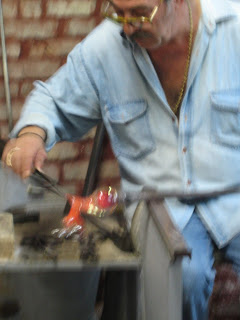
though I learnt nothing new about glass, a trip out to the island of Murano was an absolute Must, given my glass research at ECA, poems and work-in-progress novel. I was snootily amused to note that the demonstrators did not advise visitors not to look at the furnace and no green tinted glasses were provided. One of their party tricks was to place a glass jar, still molton, on the marver only a few feet away from the visitors and not to give any warning. When it shattered, making us all jump, the demonstrator just smiled. So? This is Italy. No Health and Safety obsession as in the U.K. (For that matter, no notices anywhere warning one that one might fall in the water, keep away from sloshing wakes, why, you might even slip on wet quaysides etc. OK, I'll stop now.)

The Hub manfully took on the Accademia, the Palazzo Ducale and the Peggy Guggenheim but as I had been before (aeons ago as a student) and decided then, if not now, that I can only take so many galleries and in particular, fat reclining nudes, Madonnas, melodramatic and grandiose High Rennaissance and Baroque generally, I declined smugly. However, got caught out in the Ca'Rezzonico http://www.museiciviciveneziani.it/frame.asp?musid=7&sezione=musei&tipo

Successfully managing to preserve eyes and sanity, I raced through the endless rooms lined with thousands of paintings and only paused by a few which spoke to me personally. How anyone can cope otherwise I don't know. Anyway, the ones I was drawn to were portraits by the 18th c pastel artist, Rosalba Carriera (1675-1757)- exquisitely life-like flesh tones and capture of character - especially when placed alongside the also-rans of her century. She was an Italian who moved to France, became well-known but went mad....sounds an interesting life to read up on. Just checked Wikipedia - depressive, not mad, and she went blind, (the worst fate for a painter?) possibly as result of all the miniature snuff boxes she painted.) See Two portraits at Ca'Rezzonico http://www.artcyclopedia.com/scripts/r.pl?RN47+96 http://en.wikipedia.org/wiki/Rosalba_Carriera Also enjoyed the Gaudi and Longhi which both Hub and I recognized as so well-known -e.g. the masked women and tricorned hatted men viewing a rhinocerous. A snatch of 18th c Venetian life, detailed costumes of day and social scenes a bit reminiscent of Hogarth.

Ca' d'Oro
Deciding that I actually enjoyed the architecture more than the contents of the palazzi, I also ventured inside Ca' d'Oro - exquisite, Gothic tracery, mosaic floors and early Roman and mediaeval art (a relief , it was not Baroque);


Casa Goldoni (The Marionette Museum): a miniature version of Ca' d'Oro but more simple and homely - and if you're interested, as I am as a former marionettist - an 18th c Marionette Theatre and collection of puppets - in costumes of exact detail showing the fashions of the day and even some with expressive faces.


Lastly, a quick visit to Palazzo Grassi with its ornate gold ceilings and 18th c frescos against gold background - the modern art on display (e.g. a giant blue synthetic wool spider) painfully inappropriate! Upstairs (under the eaves - maybe former servants' quarters?) where the rooms were plain white with no fancy ceilings, the modern art could be appreciated better - most striking, the photos of Mafia massacres in Palermo and the Red Brigade members wearing black masks and waving rifles, during demos and on arrest in the 70's - a reminder of the darker side of contemporary Italian political history. Not that all was roses in the past - the expansionist desires of all Europeans - Venice's own part in furthering the Crusades and conquering Constaninople, the snatch and grabbing of the 4 bronze Horses now on the balustrade of San Marco... Still, how beautiful those horses are.

I had avoided San Marco all week - the sight of the crowds on the piazza seen from the vaporetto was enough to make me refuse to step on land but the Hub cunningly took me to San Marco late at night - the deserted piazza, dark except for stars and lamps hanging below each arch of the arcades and the silhouette of the Basilica itself made me agree to go early the next morn (only 9 am but most tourists don't seem to surface till 10 am, except for a handful of Japanese groups). So the queue was bearable and we were shuffled in to the dark interior where the subject matter of the mosiaics is swallowed up in the domes, too high to distinguish much except gold tesserae glinting. But one has to go for the atmosphere. We bought the catalogue to study the mosaics in detail later. But the horses!

First we climbed up to the balustrade and went out onto the roof/balustrade and saw the copies which were beautiful enough, tho you can't see their faces and then we returned (finding ourselves face to face with Judas as you turn to the left - shocking to confront his dark figure with closed face in shadow, hanging from a tree) and so to the original bronzes and a full view. They are covered in scratches (which was apparently on purpose to prevent undue shine) but which added gravitas. The verdigris is somehow much more affecting than the cleaner copies and one can see the amazing detail of the veins in their flesh, the folds in their necks and the softness of the muzzle suggested in contrast to the broad muscular flanks. The eyes, both startled and vulnerable. Extraordinarily affecting. Whoever made these knew horses in both their beauty and power and over-strung fragility.
http://www.sacred-destinations.com/italy/venice-san-marco.htm and Scroll down. The scholars seem to have settled on AD 2nd tho no one really knows if they were Greek or Roman or who made them. And to think there was such knowledge and skill then and that whole civilization destroyed - the Byzantine art that followed has none of this realism or sensitivity (moving as it is in its mystical way - concerned with other realities). The rise and fall of civilizations, such are the musings that result coming to Italy..and the benefits of a classical education no doubt. And what if our civilizaton is destroyed and all the material skills/benefits forgotten: no sanitation, no cars or planes, no high tech surgery or drugs, no internet...perhaps no one will regret our Art 'Installations' though. Perhaps we are the new barbarians.

Sunday, 25 October 2009

Turner in Low Light, Jan 2009

19th January, 2009
Yesterday the Hub and I made our annual pilgrimage to the Vaughan Bequest of Turner paintings at the Scottish National Academy. The condition of the bequest was that the paintings should only be shown in January, having the lowest light of the year, to help preserve them. (Though since they are shown in artificial light, perhaps the low light of January is irrelevant.)

It is a wonderful restriction - since it means we actually make the effort to go every January and it makes it a more special visit. It is also a small collection which again is good because it forces one to take time and study them in more depth. I usually focus in on one or two - different ones from previous years, to really get to know them.

This year the ones that caught my eye were influenced by our Italian holiday of this summer. One of Monte Rosa because this was the mountain we could see from our rented apartment by Lake Orta. Though we only saw a sliver of the snow-capped serrated teeth of Monte Rosa tinged pink in the early morning peeping over green wooded mountains, hidden when the heat haze came down, reappearing at dusk, tinged pink at sunset, then changing to blue. We took hundreds of photos of the light changes from our window. Still, the light in my photo doesn't look up to much compared to Turner's!


From a painterly point of view, I love the 'The Sun of Venice', of boats on the Venice Lagoon for the light effects where the background has dissolved. (The gloriously golden light on the boats does not show up online. Another reason why one has to visit paintings in the 'flesh'.)
Interesting notes at the exhibition about Turner's use of blue paper. On the two occasions I have visited Venice I have never seen light effects like these. Either it was hazy in August heat, or misty in October with milky opaque water. Perhaps Turner manipulated the light effects, as he did the perspective of buildings (or even changed their position from one part of the city to another)? Another reason to return to Venice - in a different month - perhaps spring/early summer in the hope of catching such light?
Which sends me off into reminiscence. Not only is Turner reputed to have said that the light in Venice but the light on the Thames from his house on Cheyne Walk, Chelsea was the most beautiful in the world. I may not have seen this light in Venice but I did see the early morning light hazy through the mist rising off the Thames on a daily occurence back in the early 70s when I lived with a group of others off Cheyne Walk - when I say 'off', we couldn't afford the astronomical rents of Chelsea (or World's End, to be accurate) even in those days, and we lived in a houseboat! Very romantic, until rheumatism and rats finally sent me back on land. http://www.nationalgalleries.org/collection/online_az/4:322/?initial=T&artistId=5582&artistName=Joseph%20Mallord%20William%20Turner&submit=1

Impressionism and Scotland: Through Leaves

Hurrying to visit the two main Festival exhibitions ,(which are so opposite that they scream 'Not very subtle Marketing ploy' but who cares, ): Tracey Emin at the MOMA for the second time and 'Impressionism and Scotland' at the National Gallery of Scotland before it ends ,I whizz round latter. Small but beautiful. And for anyone in Scotland, interesting to see how millionaire industrialists in sugar, ships and jam were patrons both bringing the Impressionists to Scotland and supporting local 'Glasgow boys' and others. And co-incidentally on this week a TV programme on Russian oligarchs' (oil, aircraft engines) fine art investments and the mansions they display them in made the Scottish industrialist's homes look rather modest and homely.

Great to see some Imp. pictures from private collections such as F.D. Ferguson's 'A Puff of Smoke at Milngavie',* 1922 (http://www.nationalgalleries.org/whatson/exhibition/5:368/5116/5412) on loan from Lord Macfarlane of Bearsden - and therefore not so overly familiar that the eye skates over them as is the problem with so much of the Imp. works. The most interesting part for me were the selection of pictures which hung Scottish painter next to the French painter whose work influenced him...(and the exhibition continues with the influence of Matisse and Gauguin on Hunter (tho not strictly Impr. ). Colour and light of course the main influence...much needed in the gloomy north.

And just by co-incidence (following my blog entry under 18th Sept on 'through leaves' family saying) I find Peploe's 'Spring, Comrie' of buildings seen through a screen of trees hung next to a Sisley and Pissarro with the same 'through leaves' construction. Peploe may have seen these at the Caillebotte Bequest exhibition in Paris in 1897 and these two may have been influenced by Corot at Mantes in the 1860s. So it seems 'through leaves' has a prestigious pedigree.

*Note Milngavie (near Glasgow) is a trick word which Glaswegians like to test newcomers to Scotland on. Do I give the game away? Oh, go on. It's Mill - Guy. They'll never let me live this down in Glasgee now.

30.9.2008

Stories a reader brings to the story,

or viewer in a gallery. Three exhibitions on in Edinburgh this summer (2008) seem to be more about story-telling than fine art. Tracey Emin: 20 Years at the MOMA, Janet Cardiff and George Bures Miller: The House of Books has no Windows at the Fruitmarket gallery and Alex Heim's film about pigeons at the doggerfish gallery. Something in the zeitgeist? A reaction against Modernism? However, in each case content seems more important than form/line/colour etc. In each case, it's as much about how much the viewer brings to it. The viewer must use his/her imagination to complete the story to get something out of it. We usually go to the Festival exhibitions in September, once the Festival is over, in the hope it will be less crowded, but Tracey Emin was still packed, so was the Cardiff/Bures Miller. The latter by word of mouth, I suspect.

My son's friend, G, who is starting Foundation Year, raved about C/BM. He is haunting all the galleries in a crash course to find out what's current in contemporary art (what an amazing leap that summer is, the one before uni or art school). Most of the installations are in darkened spaces, reached by padded walls where one watches a scene unfold - the first one, our favourite (son, J and I) 'Opera for a Small Room'. It is a large shed, one might have at the bottom of the garden) crammed with several record-players ( a Danisette brought back memories), speakers hanging from the ceiling and hundreds of records, on shelves and piled on the floor, an out of date dial telephone, (and two curling trophies - The artists are Canadian so interesting to note the Scottish connection there.)

Spot-lights come on and off to focus on a particular record-player and they each play in turn interspersed with a voice-over: we must imagine the character, a man with a deep, gravelly voice talking to himself, a mixture of present in the moment, coughing, scratches of a stuck groove and then the screetch as the needle is moved on, with reminiscences - about a girl walking, holding shoes in her hands - immediately the viewer/listener is imagining what girl? A relationships? He is alone now, sad? Nostalgic? Lonely? What happened? Of course, we are not told.

The 'story' unfolds to different recordings, a very early singer (Caruso?), some Tosca, etc. At one point, the sound of a heavy rain storm and a train goes by, the sound moving from one side of the darkened space to the other, as all the lights dim inside the shed and the chandelier (incongruous but suitable for an opera lover) shakes to the train's vibrations. Although we, the viewers, are outside the shed looking in from windows on three sides, we are 'there' in imagination. The whole event takes 15 minutes. It is great to see a literary/artistic cross-over, or I should say 'experience', for they are timed dramas.

The viewer's complicity is highlighted in another installation 'The Killing Machine' where you have to press a red button to start it off (two dentist's drills poised above an empty reclining chair, only covered with a shag-pile rug - you must imagine the victim.) Since I guessed what it was all about I am proud to announce that I refused to press the button! However, under the reassurance from son and the Hub, that it wasn't that bad really - there is no model, no one is actually killed, I did go in and watch it. Someone else had pressed the button. (So passively I submitted to others' cruelty - like millions who stand back and do nothing, who are guility by dint of doing nothing....) I was shaken by this installation. In fact, I felt it was obscene but then I don't watch horror movies, or blood and gore, and am easily upset. No, there was no model, no one was actually killed - but they were in my imagination.

We (the Hub and I) spent some time discussing the relative merits of C/BM as opposed to Tracey Emin. I was moved by the sight of her notorious Bed. Again, because of the 'stories' I imagined - what state of mind you would have to be in to lie in such squalor, what had caused that state of mind.... (I say 'you' not 'she' because how can I really know what she felt. I have to use my imagination, so it is as much about me and people I have known). However, she has said in a TV interview, she felt a sense of celebration that she had managed to get OUT of the bed and all it symbolized. That certainly gave it a twist I would not have thought of. Maybe that's why so many people love her. She is completely honest about the sh*t of life, but also positive. She has come through. No wingeing. Just this is how it is. And I was more moved by the Bed than all of C/BM's installations. Not the Hub however but maybe it's because it is particularly female experiences Emin deals with.

We also managed to hear Emin speak at the National Gallery during the Festival and she stressed that her work is not just autobiographical ('I did go to Art School, you know!') and that what went into her work was selected. So that brings me back to the Content/Form argument. No, Emin's work shows little talent for colour, form etc but she does have an eye for selection (the found object). 'It's art because I say it is' she says (aka Duchamps). I do love the beautiful stitching though, especially the blanket edges (which I also learnt at my convent school), the patchworks and eye for line in 'F*k me' as well as the explicit pose (Egon Shielesque). The irony of the abused/exploited/tragic femine experience contrasted with the particularly femine skills of embroidery/sewing.

As for Alex Heim's pigeon film - I loved it. In a minor sort of way. It seems unfair to mention it at the same time as Emin and C/BM since it obviously palls in comparison. But it was an amusing little vignette of the day of a life, pecking, weaving in and out of aluminium chairs and table legs, human feet, scrape of paper blowing by, pecking, pecking, bit of preening, pecking at invisible motes on the pavement. You did have to watch it all through, which I did, and not just glance at it. Quite a little story (in my imagination anyway).

Which brings me to poetry (as everything does) - which I think must be an experience too, which the reader/listener must empathisize with, get involved and bring their own imagination to. The gap in a circle, which the reader/listener must close. And how is it done? The enactment of the thought processes, so the reader lives the experience -a drama unfolds? What to leave in? What to leave out? What is unsaid?
16.9.2008

Elephants, Dublin, July 2008

On our Irish holiday, July 2008 Exciting exhibition at the MOMA, formerly Kilmainham Hospital, Dublin. Miquel Barcelo exhibition: Just love the immediacy of people caught, almost in candid camera poses - silhouettes tho of colour. http://www.modernart.ie/en/page_170642.htm And the sense of humour of the statues in the grounds- in particular, an elephant . Miquel Barcelo